Comprehensive Guide to NEB LAMP Detection Methods: pH-Based vs. Fluorescent
Introduction
Are you diving into loop-mediated isothermal amplification (LAMP) and feeling overwhelmed by the various detection options? Whether you’re running a diagnostic assay or a research project, selecting the right LAMP kit and detection method is crucial for reliable results. In this comprehensive guide, we’ll break down everything you need to know about NEB’s WarmStart® LAMP products—from pH-based colorimetric mixes to fluorescent detection kits—and answer common questions about primers, dyes, and alternative readouts. Let’s get started!
1. Understanding LAMP: Why Detection Method Matters
Have you ever wondered why some LAMP reactions turn bright yellow, while others glow in a fluorescent channel? The truth is, detection strategy determines not only how you interpret results, but also the sensitivity, speed, and convenience of your assay. In a typical LAMP reaction, a high-activity DNA polymerase amplifies target DNA at a constant temperature (60–65 °C), generating byproducts (protons or magnesium pyrophosphate) that can be visualized via:
- pH Changes (Phenol Red)
- Turbidity (Magnesium Pyrophosphate Precipitate)
- Colorimetric Dyes (HNB, Malachite Green, EBT, Bromo PAPS)
- Fluorescent Dyes (NEB #B1700)
Choosing between these options hinges on your workflow, instrument availability, and whether you need quantification (fluorescence) or a simple yes/no readout (color change).
2. NEB’s pH-Based Colorimetric LAMP Kits
2.1 What Is pH-Based Colorimetric Detection?
pH-based colorimetric LAMP relies on phenol red, a pH indicator that shifts from pink → yellow when protons accumulate in the reaction as a byproduct of DNA synthesis. NEB’s specially formulated mix has a low-buffering capacity, so even small pH changes become visible.
Why pH-based?
- Visual & equipment-free: Simply look at the tube.
- Rapid interpretation: Positive reactions turn bright yellow.
- Cost-effective: No need for a real-time instrument.
2.2 NEB Products
- M1800S/L WarmStart® Colorimetric LAMP 2X Master Mix (DNA & RNA)
- M1804S/L WarmStart® Colorimetric LAMP 2X Master Mix with UDG
Key Differences:
- The M1804 kit contains UDG (uracil-DNA glycosylase), which prevents carryover contamination if you incorporate uracil into your primers.
- Both kits come pre-mixed with phenol red. Just add your primers, template, and water, then incubate at 65 °C. Watch the color change from pink → yellow if amplification occurs!
3. NEB’s Fluorescent (Non–pH-Based) LAMP Kits
3.1 What Is Fluorescent LAMP Detection?
Fluorescent LAMP uses a DNA-binding dye that emits fluorescence (typically in the SYBR/FAM channel) when intercalated into double-stranded DNA. This allows you to quantify the reaction in real time or end-point mode, offering higher sensitivity and the possibility of kinetic analysis.
3.2 NEB Products
- E1700S/L WarmStart® LAMP Kit (DNA & RNA)
- E1708S/L WarmStart® Fluorescent LAMP/RT-LAMP Kit (with UDG)
- M1708S/L WarmStart® Multi-Purpose LAMP/RT-LAMP 2X Master Mix (with UDG) (dye-free)
Key Points:
- E1700 / E1708 Kits
– Include the LAMP Fluorescent Dye (NEB #B1700) out of the box.
– E1708 has UDG to avoid carryover; E1700 does not.
– You can run these kits on any instrument with a SYBR channel. - M1708 Mix (Dye-Free)
– Contains everything except the fluorescent dye.
– Ideal if you already have a preferred dye (e.g., HNB, Malachite Green), but you’ll need to optimize that method yourself.
3.3 How Does LAMP Fluorescent Dye (NEB #B1700) Work?
The NEB #B1700 dye binds to amplified DNA and fluoresces at around 500 nm excitation. You simply add 0.5 µL per reaction, and the dye volume supplied (250 µL) supports ~500 reactions (small size: 50 µL → ~100 reactions).
4. Alternative Colorimetric Indicators (Dye-Supplemented Kits)
If you choose a dye-free mix like M1708, or if you want to have a backup detection method, you can use one of these endpoint indicators:
| Indicator | Final Concentration | Color Change | Notes |
|---|---|---|---|
| Hydroxynaphthol Blue (HNB) | 120 µM | Violet → Blue | Purchase from Sigma (CAS #63451-35-4). User-supplied. |
| Malachite Green | 0.004% (w/v) | Colorless → Green | Dissolve dye in distilled water. Citation: visual LAMP detection with MG dye. |
| Eriochrome Black T (EBT) | 120 µM | Violet → Sky Blue | Requires measuring A₆₄₀/A₅₇₀ ratio to confirm amplification. |
| Bromo PAPS + MnCl₂ | 50–100 µM + 100 µM MnCl₂ | Colorless → Red/Orange shift | Metal-sensing dye; works when manganese is chelated by pyrophosphate. |
| Turbidity | n/a (no extra reagent) | Clear → Turbid (precipitate) | Measure at 650 nm; must incubate ~60 min instead of 30 min. |
| Phenol Red (pH-based) | Pre-mixed in M1800/M1804 mixes | Pink → Yellow | Low-buffer mix creates a strong pH change that’s easy to see by eye. |
Tip: If you plan to swap the fluorescent dye with TB Green® or SYBR Green, you must optimize the concentration and confirm compatibility on your instrument. NEB #B1700 is validated for the same channel as SYBR/FAM, but alternative dyes are untested by NEB.
5. Common User Questions & Answers
Q1: “I designed my LAMP primers using Primer Explorer. Can I still use NEB’s LAMP kits without issues?”
A1: Absolutely! Although we don’t provide a Primer Explorer–specific protocol, you can cross-validate your Primer Explorer design using NEB LAMP (our online primer-design tool). On the NEB LAMP Resources page, you’ll find detailed guides and tutorials on how to design, order, and use LAMP primers with NEB kits. Comparing both tools can help ensure optimal primer performance.
Q2: “Do the WarmStart LAMP Kit (DNA & RNA) and the Colorimetric LAMP 2X Master Mix differ in dye requirements? Is NEB #B1700 enough for 500 reactions?”
A2:
- WarmStart LAMP Kit (DNA & RNA) (E1700) requires the fluorescent dye (NEB #B1700). Each reaction uses 0.5 µL, and the vial size is 250 µL, so you get roughly 500 reactions per kit. A smaller 50 µL vial yields ~100 reactions.
- WarmStart Colorimetric LAMP 2X Master Mix (DNA & RNA) (M1800) is dye-free because it uses phenol red for pH-based detection. You do not need any fluorescent dye for that kit.
Q3: “For kits that come with fluorescent dye, can I substitute TB Green or SYBR Green?”
A3: We have not validated TB Green or SYBR Green in our LAMP assays. While the NEB #B1700 dye operates on the same SYBR/FAM channel, using an alternative dye requires you to optimize concentration, instrument settings, and confirm that your real-time instrument can detect emission properly. Proceed with caution, and run a control experiment to ensure reliable detection.
6. Step-by-Step LAMP Workflow Using NEB Kits
-
Design Primers
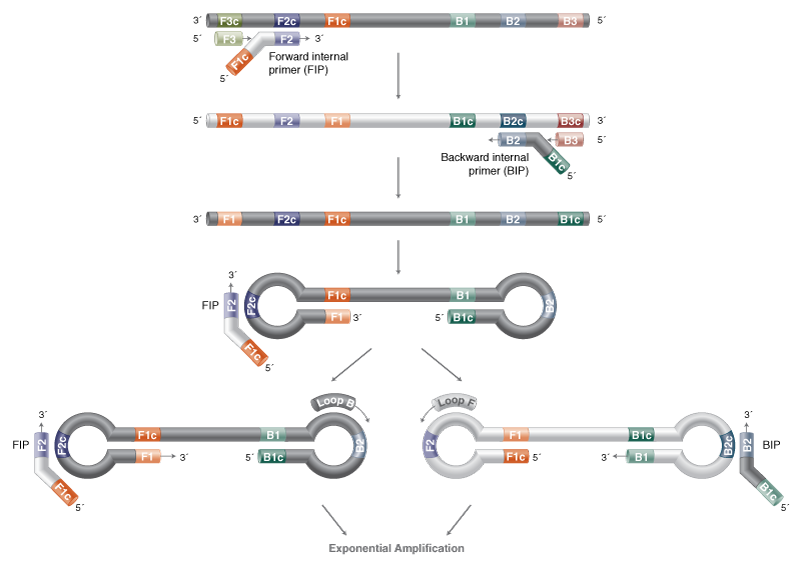
– Use NEB LAMP or Primer Explorer to generate 4–6 primers (F3, B3, FIP, BIP ± Loop primers).
– Verify Tₘ values (60–65 °C optimal) and avoid secondary structures. -
Set Up Reaction
– pH-based Mix (M1800/M1804):
• 12.5 µL 2X master mix (with phenol red)
• 2.5 µL primer mix (total primer concentration ~2–2.5 µM)
• X µL template (1–10 ng purified DNA/RNA)
• Add nuclease-free water up to 25 µL.
– Fluorescent Mix (E1700/E1708):
• 12.5 µL 2X master mix (includes NEB #B1700 dye)
• 2.5 µL primer mix
• X µL template
• Add water to 25 µL.
– Dye-Free Mix (M1708):
• 12.5 µL 2X master mix
• 2.5 µL primer mix
• X µL template
• Add your chosen dye (e.g., 0.5 µL NEB #B1700 or 120 µM HNB).
• Bring volume to 25 µL. -
Incubate
– 65 °C for 30 minutes (fluorescence) or 60 minutes (turbidity-colorimetric methods).
– If using HNB/Malachite Green/EBT, cool tubes to room temperature once complete; colors become more distinct upon cooling. -
Readout
– M1800/M1804 (phenol red): Observe color change pink → yellow.
– E1700/E1708 (fluorescent): Real-time or end-point read via SYBR/FAM channel.
– M1708 + HNB: Color shifts violet → blue.
– M1708 + Malachite Green: Color shifts colorless → green.
– M1708 + EBT: Color shifts violet → sky blue; measure A₆₄₀/A₅₇₀ for quantification.
– Turbidity: Measure absorbance at 650 nm; turbidity indicates successful amplification.
7. Tips for Optimal LAMP Performance
- Primer Quality: Always use HPLC-purified primers for best results.
- Template Concentration: Too much template can cause non-specific amplification; aim for 1–10 ng per reaction.
- Incubation Time: If your signal is weak, extend the incubation by 10–15 minutes, but watch for non-specific artifacts.
- UDG Carryover Prevention: If you plan to run many sequential LAMP reactions from previous amplicons, choose UDG-containing kits (M1804 or E1708) to minimize contamination.
- Alternative Dye Validation: If substituting TB Green or SYBR Green, run a standard curve to ensure linear response and no inhibition.
- Negative Controls: Always include a no-template control (NTC) to catch contamination early.
8. Conclusion
In summary, NEB’s WarmStart® LAMP portfolio covers a wide array of detection methods to suit different workflows:
- M1800 / M1804 (pH-based phenol red) → Visual, no instrument required.
- E1700 / E1708 (fluorescent) → Quantitative, real-time tracking.
- M1708 (dye-free) → Customizable, for users who prefer HNB, Malachite Green, EBT, or Bromo PAPS.
By understanding the advantages and limitations of each method—speed, sensitivity, equipment needs, and cost—you can confidently choose the right kit for your project.
Ready to start LAMPing? Select your kit based on your detection preference, design your primers (via NEB LAMP or Primer Explorer), and enjoy seamless, reliable amplification with NEB’s WarmStart reagents. Happy amplifying!


