A Complete Analysis of the Key Tool in Phage Display
Bacteriophage M13
Hello, dear readers of the biotechnology blog! Today, let's embark on a journey into the fascinating world of microbiology. We'll explore tiny, invisible entities that profoundly impact our lives: viruses. More specifically, we'll delve into bacteriophages, the special viruses that infect and replicate only within bacteria. Our focus will be on a particular friend, the M13 phage, and how it's become a pivotal tool in cutting-edge biotechnology known as phage display.
Aren't you curious? How did this minuscule entity come to shine in diverse fields, from disease treatment to drug discovery? Join me now as we dive deep into the world of bacteriophages!
What Are Bacteriophages and How Diverse Are They?
Bacteriophages, often shortened to phages, are viruses that exclusively infect and replicate within bacteria. They exhibit an astonishing diversity in morphology, genomic organization, and size. However, they can be broadly classified based on their replication method: lytic or lysogenic.
Lytic phages rapidly utilize all of the host cell's resources to build more phages, manufacturing their proteins by hijacking the host cell's ribosomes. This process ultimately lyses the cell, releasing new bacteriophages to infect more bacteria. Think of it as a lightning-fast strategy of proliferation and destruction.
In contrast, lysogenic phages do not lyse the host cell. Instead, they either integrate their genome into the host cell's chromosome or maintain it as an episomal element, allowing both the phage and the cell to replicate without destroying the host. They coexist with the host, quietly increasing their numbers. Some phages, called temperate phages, can even begin their life as lysogenic and then switch to a lytic replication cycle depending on environmental conditions. They're like spies who lie in wait, activating at the opportune moment.
Phages can also be differentiated by the type of DNA or RNA in their genome. They can contain double-stranded DNA (dsDNA), circular single-stranded DNA (circular ssDNA), or RNA. Commonly used phages like T7, T4, and Lambda consist of dsDNA, whereas M13, fd, and fl contain circular ssDNA. All of these are classified under orders such as Caudovirales and Tubulavirales, and then further subdivided into families. While the majority of phages fall under the Caudovirales order, the filamentous phage M13, crucial for phage display, belongs to the Tubulavirales order.
Summary Bacteriophages are classified by their infection method (lytic for rapid destruction, lysogenic for coexistence) and genome type (dsDNA, ssDNA, RNA). The M13 phage, a filamentous phage, contains ssDNA.
The Star of Phage Display - Introducing the M13 Phage!
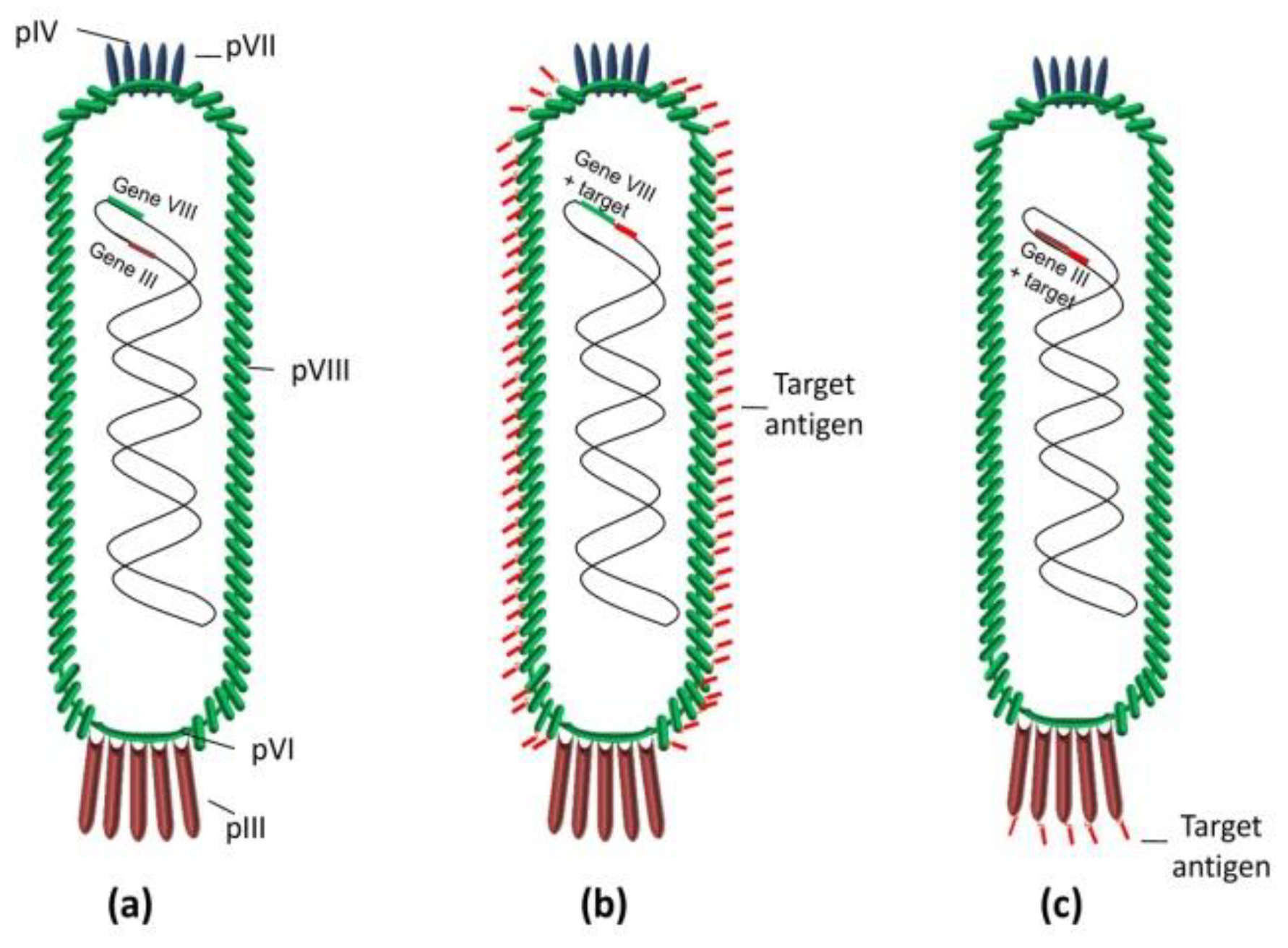
Now, let's dive into the M13 phage, the central player in phage display technology. The M13 phage is called a filamentous phage because of its rod-shaped morphology. Its genome is approximately 6.4 kb of circular single-stranded DNA (circular ssDNA), comprising three types of genes: replication, assembly, and structural.
- Replication genes: gII, gX, and gV
- Assembly genes: gIV, gI, and gVI
- Structural genes: gVII, gIX, gVIII, gIII, and gVI
Notably, gVIII codes for the major capsid/coat protein, pVIII, while gVII, gIX, gIII, and gVI code for the minor capsid/coat proteins. The pIII protein is particularly important, consisting of N1 and N2 domains. The N1 domain initiates the translocation of the phage's DNA into the host genome, and the N2 domain's purpose is to recognize the host cell. It is precisely this N2 domain of the pIII gene that is the primary target in phage display technology.
The M13 phage uniquely infects only E. coli and primarily participates in lysogenic replication. The phage binds to the cell's surface and enters through a pore-like structure, releasing its DNA into the host cell's cytoplasm. The cell then transforms the phage's circular ssDNA into a double-stranded plasmid, which subsequently produces the phage's ssDNA and forms templates for protein expression. pV dimers bind to newly synthesized viral ssDNA, preventing its conversion to its parental replicative form. When enough pV is present, the majority of DNA replication shifts to the synthesis of viral ssDNA. Once this is complete, proteins pII, pX, and pV remain in the cytoplasm, while the others are secreted to the cytoplasmic membrane. The M13 phage is assembled in the periplasm and secreted through the cell membrane. This entire process is how DNA is amplified in a phage display workflow, making it a powerful system for molecular biology applications.
Summary: M13 phage is a filamentous, ssDNA virus that infects E. coli. Its pIII protein, specifically the N2 domain, is key for host recognition and is central to phage display. Its lysogenic replication in E. coli allows for efficient DNA amplification.
The M13KE Cloning Vector - Enabling Phage Library Construction
The M13KE cloning vector plays a crucial role in designing phage libraries. This vector consists of circular dsDNA and is designed to produce an M13 phage with ssDNA containing the target DNA sequence for a desired peptide. It is derived from M13mp19, which simplifies library construction by eliminating the need for antibiotic selection or helper phage superinfection.
The M13KE cloning vector also contains dsDNA and infects E. coli, undergoing a very similar replication cycle to M13 phages. Extensive sequencing of naïve libraries prepared using this vector system has revealed minimal sequence bias, except for selection against unpaired cysteine residues (unpublished observations) and expected reduced levels of arginine (but not lysine) residues. The reduced arginine levels are likely due to the secY-dependent secretion of pIII, which can be overcome, if desired, by using a prlA suppressor strain for library amplification.
Its genome has been modified to include a gene for the lac repressor (lacI) protein, the operator-proximal region of the lacZ gene, a lac promoter upstream of the lacZ gene, and a polylinker region inserted into the lacZ gene. Consequently, all M13 phages produced by this cloning vector will also carry the lacZ gene. Since the lacZ gene is not naturally occurring in M13 phages, its presence can be utilized to detect contamination when performing a titer via **blue/white screening**. The IPTG/Xgal in the agar promotes the synthesis of β-galactosidase, which produces blue plaques. Any contaminating phage, lacking the lacZ gene, will produce colorless plaques on the plate, making contamination easily identifiable. This genetic modification is a clever way to ensure the purity and integrity of your phage libraries.
Summary: The M13KE cloning vector is a dsDNA vector derived from M13mp19, essential for creating phage libraries. It infects E. coli and includes the lacZ gene for blue/white screening, simplifying contamination detection.
Phage Display and Biopanning - The Workflow Unveiled
Phage display is a powerful laboratory technique that allows researchers to study protein–protein, protein–peptide, and protein–DNA interactions. It works by "displaying" a foreign protein (or peptide) on the surface of a phage.
Creation of Peptide and Phage Libraries
The process begins with the creation of peptide libraries, which are vast collections of billions of DNA clones containing target sequences that encode specific peptides. These DNA sequences are then cloned into the gIII region of the M13 phage genome using a cloning vector, such as M13KE, or a phagemid system. This insertion creates a critical linkage between genotype and phenotype: the inserted peptide (genotype) is displayed on the phage surface (phenotype). The result is a phage library, containing millions of M13 phages, each displaying a different peptide. While distinct, the terms 'peptide library' and 'phage library' are often used interchangeably due to this direct link.
Workflow - From Selection to Identification
A typical phage display workflow, also known as biopanning, begins with a researcher seeking to investigate the interaction between a specific peptide and a particular target.
- Target Coating: The target molecule (e.g., a protein or small molecule) is coated onto a bead or plate.
- Library Incubation: The chosen phage library is then incubated on this coated surface. Only specific phages within the library, those displaying peptides with an affinity for the target, will bind to it.
- Washing: Unbound phages are carefully washed away, leaving only the phages that have successfully bound to the target. At this stage, performing a titer is optional; it serves to verify how many phages were washed away.
- Elution: The bound phages are then eluted from the target.
- Amplification: The eluted phages are amplified in E. coli, and another titer is performed to quantify the amplified phages.
- Repeated Rounds: This cycle of incubation, washing, elution, and amplification is repeated 2-3 times. Each round enriches the pool of selected phages, gradually leading to the isolation of peptides with optimal binding affinity to the target.
- Sequencing and Validation: After the second or third round, the peptide-encoding insert sequence of selected clones is determined. Concurrently, an ELISA or an alternative specificity assay is performed to confirm the binding. Sequencing templates are obtained by amplifying phage from single plaques, followed by a single-stranded DNA purification step. The specificity of a clone for a given target is confirmed after selections by a disparate assay using the entire phage clone or a custom synthetic peptide.
Companies like NEB often provide M13KE phages (E8101) that can be used to create custom libraries. However, researchers can also opt for pre-made phage libraries, which eliminate the need for initial cloning steps, streamlining the workflow significantly.
Summary: Phage display, or biopanning, involves creating peptide libraries displayed on M13 phages. The workflow includes coating a target, incubating a phage library, washing unbound phages, eluting bound phages, and amplifying them. This cycle is repeated to enrich for high-affinity binders, which are then sequenced and validated.
Common Applications of Phage Display
Phage display has a wide array of applications, particularly relevant to antibodies and proteins. While some products are tailored for general antibody and protein studies, many are specifically designed for peptide applications. These include:
- Anti-microbial/viral peptides: Identifying peptides that can combat bacterial or viral infections.
- Material-specific peptides: Discovering peptides that bind to particular materials, useful in fields like nanotechnology or diagnostics.
- Small molecule binders: Finding peptides that can bind to small molecules, which can be crucial for drug discovery.
- Novel enzyme substrates: Identifying new substrates for enzymes, aiding in enzyme characterization and pathway analysis.
- Mapping of protein-protein interactions: Understanding how proteins interact with each other. For example, researchers use this to identify both known and unknown protein binding patterns, investigating the specificity of their interactions. This helps in unraveling complex biological pathways and disease mechanisms.
- Epitope mapping - Pinpointing the specific regions on an antigen that antibodies recognize.
Phage display is truly a versatile and powerful technique, continually opening new avenues in research and development across various scientific disciplines.
Keywords: Bacteriophage, Phage, M13 Phage, Phage Display, M13KE Cloning Vector, Peptide Library, Biopanning, Lytic, Lysogenic, Antimicrobial Peptides, Protein Interaction

